
Artificial intelligence is reshaping global power structures, and every major region understands the stakes. From national security to economic growth and technological sovereignty, the “AI race” is no longer a metaphor — it’s a defining competition of the 21st century.
But the race isn’t a single contest. It’s split into several tracks: research, regulation, hardware, commercialization, data access, and long-term innovation. Each region leads in different areas. Here’s where things stand today.
🇺🇸 United States: Innovation Leader and Home of the AI Giants
The U.S. remains the center of global AI innovation. Its advantages are structural and deeply entrenched:
1. Unmatched private-sector strength
OpenAI, Google DeepMind (co-based in the UK but U.S.-driven), Anthropic, Meta, NVIDIA, Microsoft — Silicon Valley and its partners set the global pace in model development and compute infrastructure.
2. Dominance in advanced chips
NVIDIA controls an overwhelming share of the world’s high-performance AI GPU market. AMD is quickly improving. U.S. export controls also shape how other countries can build large-scale AI systems.
3. Strong research ecosystem
Leading universities — MIT, Stanford, Berkeley — continue to publish breakthrough AI research, feeding talent into private and public sectors.
Where the U.S. lags:
- Regulation is fragmented and slow compared to the EU.
- Hardware manufacturing relies heavily on Taiwan.
- Public-sector AI adoption moves slower than China’s.
Bottom line:
The U.S. is still the global innovation hub and shapes the commercial frontier of AI.
🇨🇳 China: Scale, State Direction, and a Rapidly Expanding AI Ecosystem
China is not far behind — in some categories, it may even be ahead.
1. Massive data advantage
China’s population size and digital infrastructure generate enormous datasets that fuel AI training and deployment.
2. State-driven acceleration
China’s AI strategy is centralized and long-term. Major companies — Baidu, Alibaba, Tencent, ByteDance — build models supported by national priorities.
3. World-class adoption speed
China deploys AI in finance, logistics, manufacturing, and smart-city infrastructure at a scale unmatched by the U.S. or Europe.
Where China struggles:
- Advanced semiconductor restrictions make access to cutting-edge chips difficult.
- Geopolitical scrutiny limits export growth of Chinese AI tools.
- Some global markets hesitate to adopt Chinese tech due to privacy concerns.
Bottom line:
China leads in scale, deployment speed, and applied AI, but chip constraints remain a major strategic challenge.
🇪🇺 European Union: The Global Regulator and Ethics Standard-Setter
Europe approaches AI differently: it’s not trying to out-build Silicon Valley or out-scale China. Instead, the EU aims to shape the governance and safety standards the rest of the world will eventually follow.
1. The EU AI Act — the world’s first comprehensive AI regulation
Europe is pioneering a rules-first approach: transparency, safety, high-risk system controls, and consumer protection. The Act will influence global companies that want access to the EU market.
2. Strong academic base
European universities produce top-tier AI research, especially in robotics, safety, and machine learning theory.
3. Growing but fragmented innovation
While Europe hosts major players like DeepMind (UK), Mistral AI (France), and Aleph Alpha (Germany), the region lacks a unified tech ecosystem or mega-scale investors comparable to the U.S.
Where the EU lags:
- Limited large-language-model development compared to U.S./China.
- Higher compliance costs for startups.
- Slow to commercialize breakthroughs.
Bottom line:
Europe leads the regulatory and ethical front, but trails in large-scale AI model development and commercialization.
So Who Is Actually Winning?
It depends on the metric:
🏆 Innovation & Model Performance: United States
The most advanced foundation models still come from U.S. companies.
🏆 Adoption & Real-World Deployment: China
China integrates AI into everyday services faster and at greater scale than any other region.
🏆 Governance & Standards: European Union
The EU is shaping the global rulebook and pushing for responsible AI development.
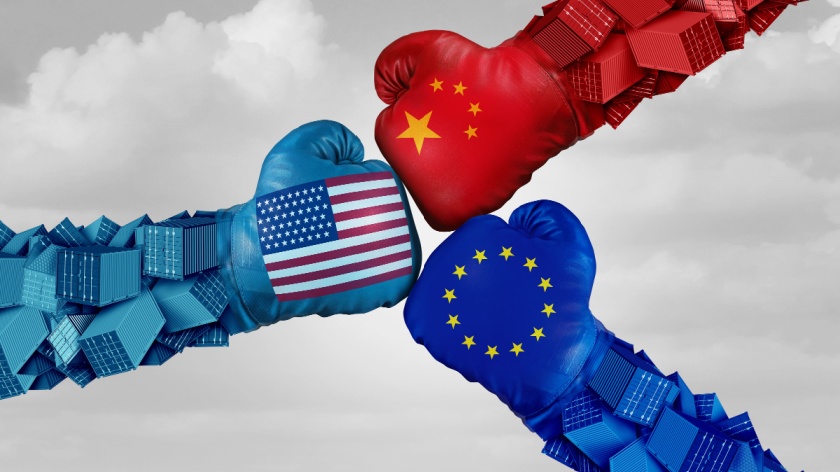
The Real Outcome: A Three-Way Balance of Power
The AI race isn’t about one winner. It’s about who will shape the future of the technology — and on whose terms.
- The U.S. drives innovation and compute.
- China drives scale and real-world deployment.
- The EU drives rules, safety, and consumer protection.
Together, they form the three pillars of global AI development — and the outcome of this competition will influence economics, geopolitics, and technology for decades.