Introduction: When Economics Became the Battlefield
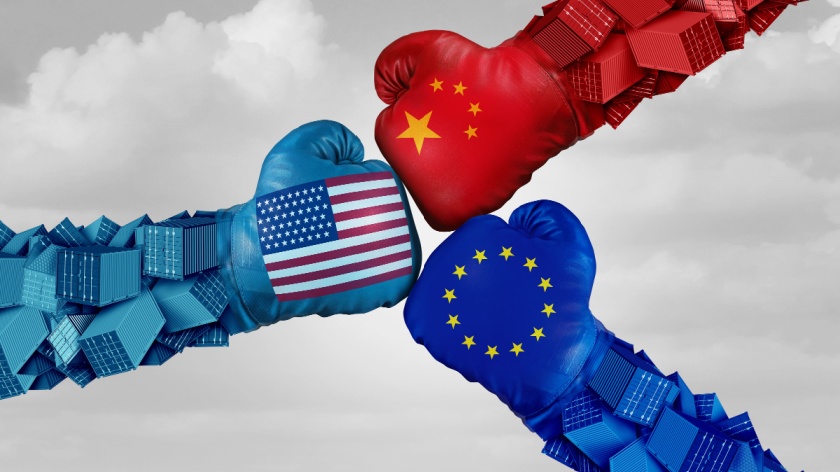
The year 2025 will be remembered not for a single military conflict, but for a far more pervasive and enduring struggle: the escalation of the global economic war. Unlike traditional wars, this confrontation was fought not with tanks or missiles, but with tariffs, sanctions, subsidies, currency pressure, export controls, and control over data, technology, and supply chains. At the center of this economic battlefield stood the United States — not alone, but as the primary architect of a system where economic power became a weapon of strategic influence.
- Introduction: When Economics Became the Battlefield
- The United States: Architect of Economic Pressure
- China: From Target to Counter-Strategist
- Europe: The Reluctant Participant
- The Global South: Collateral Damage and Opportunity
- Technology: The True Frontline of the Economic War
- Who Won the Economic War of 2025?
- Conclusion: A World Permanently Changed
By the end of 2025, it became clear that the world had crossed a point of no return. Globalization as it existed for decades was fundamentally altered. Trust between major economies eroded, trade blocs hardened, and economic policy became inseparable from national security. The economic war did not produce a single winner — but it reshaped every major economy on the planet.
The United States: Architect of Economic Pressure
The United States entered 2025 with a clear strategic vision: preserve technological dominance, protect domestic industries, and prevent strategic rivals from controlling critical nodes of the global economy. Washington increasingly viewed open markets not as neutral spaces, but as arenas of competition.
Tariffs as Strategic Tools
Throughout 2025, the U.S. expanded and refined its tariff regime. What began years earlier as trade disputes evolved into targeted economic pressure. Tariffs were no longer blunt instruments; they became precision tools aimed at semiconductors, electric vehicles, clean energy components, steel, and advanced manufacturing.
The goal was not only to reduce imports but to reshape supply chains in favor of “trusted partners.” As a result, the U.S. pushed aggressively for “friend-shoring” — relocating production to allied nations while limiting exposure to geopolitical rivals.
Sanctions and Financial Power
America’s dominance of the global financial system remained its most powerful weapon. The dollar’s central role in trade, debt, and reserves allowed Washington to enforce sanctions with unprecedented reach. In 2025, sanctions were expanded not just against states, but against corporations, logistics networks, technology providers, and even research institutions.
However, this power came with unintended consequences. The more aggressively sanctions were used, the more incentive other countries had to build alternatives — from non-dollar payment systems to regional financial infrastructure.
China: From Target to Counter-Strategist
China was not merely a victim of economic pressure; by 2025 it had become a sophisticated practitioner of geoeconomic strategy itself. Beijing responded to U.S. actions not symmetrically, but strategically.
Export Controls and Resource Leverage
China increasingly used its dominance in critical raw materials — rare earths, battery minerals, and processing capacity — as leverage. Export restrictions, licensing requirements, and regulatory delays became tools of retaliation.
Rather than open confrontation, China opted for ambiguity: measures that complied with international rules on paper, while still exerting pressure in practice.
Domestic Substitution and Tech Independence
One of the most profound outcomes of the economic war was China’s acceleration toward technological self-reliance. By 2025, massive state investment had reshaped entire industries, from AI chips to industrial robotics. While China still lagged in some high-end technologies, the gap narrowed significantly.
Ironically, U.S. pressure — intended to slow China’s rise — ended up accelerating Beijing’s long-term decoupling from Western technology.
Europe: The Reluctant Participant
Europe found itself caught between economic giants. While the EU shared many of Washington’s security concerns, it was deeply dependent on global trade and vulnerable to fragmentation.
Tariffs, Subsidies, and Internal Tensions
European industries were hit by both U.S. and Chinese measures. American subsidies under industrial policy programs drew investment away from Europe, while Chinese competition undercut European manufacturers.
In response, the EU adopted its own defensive economic policies — screening foreign investments, imposing carbon border taxes, and increasing subsidies. However, internal divisions slowed decision-making and weakened Europe’s strategic coherence.
Strategic Autonomy — Still a Promise
By the end of 2025, “strategic autonomy” remained more aspiration than reality. Europe sought independence in energy, defense, and technology, but lacked the unified political will to fully break free from reliance on external powers.
The Global South: Collateral Damage and Opportunity
For developing economies, the economic war of 2025 was both a threat and an opportunity.
Fragmented Trade Routes
As global supply chains fractured, many countries in Southeast Asia, Latin America, and Africa became alternative manufacturing hubs. Vietnam, Mexico, India, and Indonesia benefited from investment flows redirected away from China.
Yet volatility increased. Sudden policy shifts by major powers created uncertainty, currency instability, and debt pressure — particularly for nations dependent on exports or dollar-denominated loans.
Choosing Sides — or Refusing To
Many countries resisted aligning fully with any bloc. Instead, they pursued transactional diplomacy, extracting benefits from multiple partners while avoiding firm commitments. The result was a more multipolar but also more unstable economic system.
Technology: The True Frontline of the Economic War
If one sector defined the economic war of 2025, it was technology.
AI, Semiconductors, and Data
Control over artificial intelligence, advanced chips, and data flows became synonymous with power. Export bans on AI hardware, restrictions on research collaboration, and data localization laws created a digital Iron Curtain.
Innovation did not stop — but it became regionalized. The world moved toward parallel tech ecosystems with limited interoperability.
The Cost of Fragmentation
While governments framed these measures as necessary for security, the cost was enormous. Innovation slowed, duplication increased, and global efficiency declined. Consumers paid higher prices, and smaller companies struggled to survive in a fractured digital world.
Who Won the Economic War of 2025?
The honest answer: no one — at least not in the traditional sense.
- The United States preserved its dominance but at the cost of higher inflation, strained alliances, and accelerating global resistance to dollar hegemony.
- China reduced vulnerability and strengthened internal capacity, but faced slower growth and reduced access to global markets.
- Europe avoided collapse but failed to assert decisive leadership.
- The global economy became less efficient, more politicized, and more fragile.
What did emerge was a new reality: economic warfare is now permanent. It is no longer an emergency measure but a standard instrument of statecraft.
Conclusion: A World Permanently Changed
The economic war of 2025 did not end with a treaty or a ceasefire. Instead, it marked the normalization of conflict through markets. Trade, finance, and technology are no longer neutral spaces — they are weapons, shields, and bargaining chips.
The world that followed is one of guarded cooperation, strategic distrust, and constant recalibration. Nations learned that economic interdependence can be both a source of strength and a critical vulnerability.
As the dust settled, one lesson stood above all others: in the 21st century, power is no longer defined solely by military might, but by who controls the flows of money, technology, data, and trust. And that battle is far from over.